


Reciprocating Gas Compressors

Our Ration for the course : 4.7 Start Based on 56 users

Types of gas compressors and its application

Reciprocating compressor description of component and performance

Reciprocating compressor typical thermo dynamic calculations

Reciprocating compressor performance and characteristics

Maintenance and trouble shooting for typical practical examples for gas compressors
| Name of Course | Scheduled Dates | Vanue | Registration Link |
|---|---|---|---|
| Reciprocating Gas Compressors | To be determined | Abu Dhabi, UAE | Registration Now |
-

Mechanical Engineers, technicians and maintenance foremen
To enroll or register to any training course, you can use the registration page from training page or fill the request a call back form from each course pages.
The following page will provide you a list of course and training that we are providing based on the category and from each course item you can see the course details.
URL: https://nbizinfosol.twtests.co.in/training.aspx
Another method is to fill a Request a call back form provided in each Training/Course pages.
We are providing course materials during training and completion certificate after succesful training.
Yes. you can fill the registration form avaialble in the website or you can directly call us to enroll the course.Our executives will guide you to do further steps.
Based upon the course you are enrolling, we will charge the exam fee . We will give you the details of course fee and exam fee anytime to clear it.
Yes. We are providing the Course completion certificate for all courses we are providing.
Yes. We will provide assistance and support to apply for any exam.
Two types of payment available:
1. Visit our office and pay direct,You are always welcome to Nbizinfosol.
2. We are providing online payment via paypal payment gateway.Based upon your request we will provide the link to access the payment page.
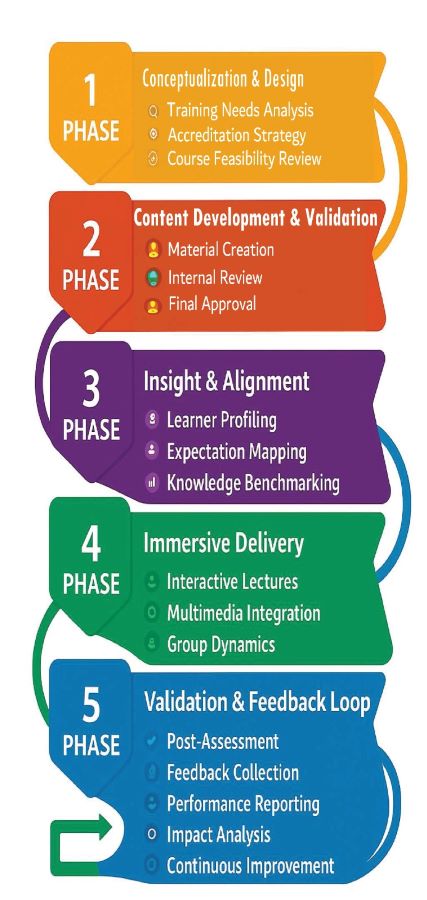
Phase 1: Conceptualization & Design
- 🎯 Identify core training needs based on market gaps and learner profiles.
- 📄 Map accreditation and compliance requirements early.
- 🧩 Assess delivery feasibility across formats.
Phase 2: Content Development & Validation
- ✍️ Create structured modules with clear outcomes.
- 🔍 Validate content with SMEs.
- ✅ Refine materials for certification readiness.
Phase 3: Insight & Alignment
- 🧠 Profile learner expectations and backgrounds.
- 📍 Use benchmarks to align goals.
- 📊 Adjust delivery based on feedback and data.
Phase 4: Immersive Delivery
- 🎥 Use simulations and multimedia tools.
- 💻 Adapt in real-time to feedback.
- 👥 Foster peer learning and collaboration.
Phase 5: Validation & Feedback Loop
- 📈 Assess retention and application.
- 💬 Collect structured feedback.
- 🔄 Analyze metrics to restart lifecycle.


.PNG)

.PNG)


 Special Offers
 GET OUR BEST DEALS!